
Adams County Court Records After Arrest
After an Adams County jail arrest, the jail and the court do different work. ACACC intake handles confinement, property, medical screening, initial calls, classification, and jail identifiers. The court side begins with the Pennsylvania criminal process: complaint or arrest papers, preliminary arraignment before an issuing authority, bail decision, preliminary hearing in a magisterial district court, and later Court of Common Pleas proceedings if charges move forward. The court record is the docket and filing trail, not the jail's internal custody file.
The Adams County Clerk of Courts public criminal records page says criminal records are open to the public and directs statewide searches through the Unified Judicial System. UJS provides public docket sheets for appellate, common pleas, and magisterial district cases. Recent entries can lag, and secure docket services may require approval, but the free public docket is the core tool for court records after a jail arrest in Adams County.
Booking or custody questions belong with Adams County jail inmate records. Booking photos and public-photo limits belong with Adams County jail mugshots. The court-record search focuses on charges, hearings, bail, case status, disposition, and court costs.
Find Adams County Court Records
Start with Pennsylvania UJS Case Search. Search by participant name when only the person's name is known. Use a docket number, offense tracking number, police incident number, complaint number, or state ID number when available, because common names can return unrelated results. Narrow by Adams County and the correct court level when the portal allows it.
- Open UJS Case Search and choose a criminal docket search path.
- Search by the defendant's full legal name, then narrow by Adams County and court level.
- Use docket number, OTN, police complaint number, or incident number if those identifiers are known.
- Check both Magisterial District Court and Court of Common Pleas records, because early events may start at the MDJ level.
- Read charges, grading, status, scheduled events, bail entries, disposition, and financial entries on the docket sheet.
The UJS case information page explains public and secure docket sheets, criminal calendars, correction requests, and technical requirements. The Adams County Clerk page also notes that in-person research is available during office hours, with public computers for criminal records dating back to 1986.
The UJS Case Search portal is the public statewide search point for Adams County criminal docket sheets.
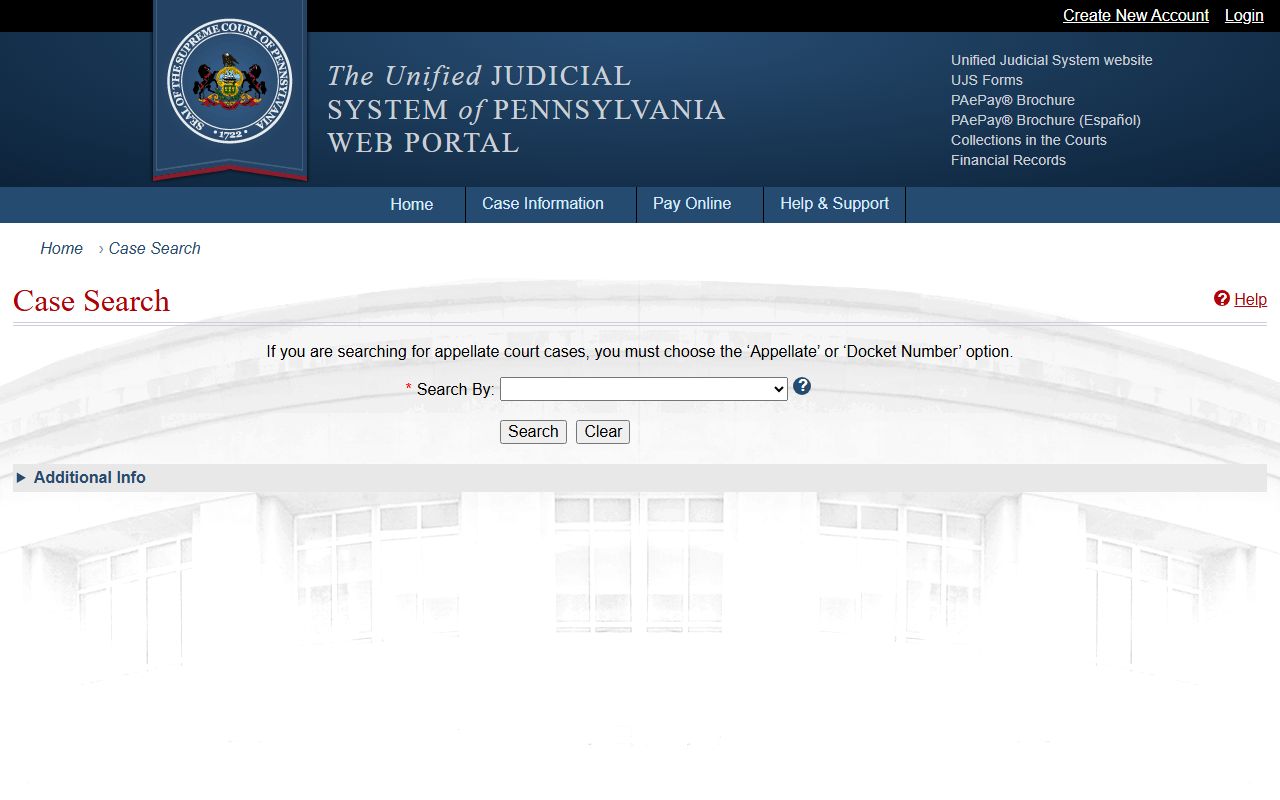
The UJS search screen supports several identifiers, which helps when an arrest name is common or a docket number is already known.
Adams County Court Search Fields
The UJS portal and Clerk records process give Adams County users several ways to move from an arrest to a court case. The more exact the identifier, the easier it is to avoid matching the wrong person. The OTN is especially useful in Pennsylvania because it can connect arrest-processing information to court filings.
| Field Label | Type | Required | Options / Format Notes |
|---|---|---|---|
| Case number | Text | Optional | Use the docket number when it is known. |
| Participant name | Text | Optional | Search by defendant or participant name. |
| Organization name | Text | Optional | Available for organization-name searches. |
| Offense tracking number | Text | Optional | Search by OTN where known. |
| Police incident or complaint number | Text | Optional | Useful when the arrest paperwork gives a complaint or incident number. |
| County | Dropdown / filter | Optional | Select Adams County when narrowing results. |
| Court level | Tab / filter | Optional | Check magisterial district and common pleas levels when needed. |
Charges Filed After Arrest
A jail booking can list an arrest reason, but formal court charges can change as the prosecutor reviews the case. The Adams County District Attorney's Office prosecutes criminal cases for the Commonwealth in Adams County. Research identifies Brian Sinnett as District Attorney, with the office at the Adams County Courthouse on Baltimore Street. The DA may approve charges, amend them, withdraw charges, negotiate pleas, or proceed to trial.
| Document | Who Uses It | What It Starts or Shows |
|---|---|---|
| Complaint | Police or prosecution path | Initial criminal allegations and case-starting facts, often at the magisterial district level. |
| Information | Prosecutor | Formal common pleas charging document after charges are held for court or filed at that level. |
| Indictment | Grand jury process | Formal charges through a grand jury path, less common in routine local cases. |
Do not treat the first arrest label as the final case result. A charge can be amended, held, withdrawn, dismissed, merged for sentencing, or resolved by plea or verdict. The docket sheet is the best public place to watch that change over time.
Charge Status Records
Charge status terms show where a count stands in the court process. They are not the same as custody status. Someone can be released while charges remain pending, or held on a detainer while a local charge appears resolved. Read the docket event history along with the charge table.
| Status | Plain Meaning | Search Note |
|---|---|---|
| Pending | The charge is still active in the case. | Check the next scheduled hearing or court event. |
| Held for court | The charge moved beyond a preliminary stage toward common pleas proceedings. | Look for a common pleas docket if one is created. |
| Amended or reduced | The charge changed from its earlier form. | Compare old and new count descriptions. |
| Withdrawn or dismissed | The count is no longer being pursued in that form. | Review whether other counts remain active. |
| Disposed | The count has an outcome by plea, verdict, dismissal, or other disposition. | Disposition does not always explain current custody. |
Bail Records After Arrest
Pennsylvania Rule 540 governs preliminary arraignment and says that after preliminary arraignment, if the defendant is detained, the defendant must have an immediate and reasonable opportunity to post bail, secure counsel, and notify others of the arrest. Rule 523 governs release criteria, and Rule 528 covers monetary conditions such as cash, percentage cash, realty, professional bondsmen, and surety company bonds.
| Bail or Hold Type | How It Works in Adams County Case Records |
|---|---|
| Recognizance or nonmonetary release | Release based on conditions rather than upfront payment when the bail authority finds it sufficient. |
| Unsecured bail | A monetary amount is set, but no upfront deposit is made unless the defendant fails to appear or comply. |
| Percentage cash bail | Rule 528 allows deposit up to 10 percent of the full monetary condition when permitted. |
| Surety bond | A professional bondsman or authorized surety company secures the release. |
| Detainer or other hold | Another county, state parole, federal, or immigration hold may prevent release even after local bail is handled. |
The official research did not locate a standalone ACACC bail counter schedule. Verify payment steps with the issuing authority, Clerk of Courts, or ACACC before traveling.
Adams County Clerk Records
Some court records after a jail arrest require Clerk of Courts research rather than a simple UJS search. The Clerk page says records may be researched and viewed in person during regular business hours. Two public computers are available for criminal records dating back to 1986, including some older matters with balances in that year. Historical records from 1910 through 1986 use docket books and microfiche. Records from 1800 to 1910 route to the Pennsylvania Historical Museum Commission, and pre-1800 records route to the York County Historical Society.
| Record Path | Adams County Detail |
|---|---|
| 1986-present public computers | Available through the Clerk of Courts Office for criminal records. |
| 1910-1986 | Docket books and microfiche. |
| 1800-1910 | Pennsylvania Historical Museum Commission. |
| Pre-1800 | York County Historical Society. |
| Mail copy requests | Use the Request for Access Form, required fee, and self-addressed stamped envelope. |
Warrants and Arrest Records
The Adams County Sheriff publishes warrant and most-wanted content through CRIMEWATCH. The sheriff page identifies Sheriff Joshua Fitting, lists the Sheriff's Office address and phone, and includes Warrants and Most Wanted navigation. Warrant profiles may show a name, charge headline, age, race, gender, height, weight, hair, eyes, presumption notice, location, issue date, active status, docket number, issuing authority, and a Submit a Tip function.
Warrants are not the same as court records after arrest, but they often explain why the arrest happened. A bench warrant, probation/parole warrant, domestic relations warrant, or out-of-county warrant may affect release even when the Adams County docket seems straightforward.
Charges Convictions Sealed Expunged
Court records after an Adams County arrest must be read with care. A charge is an accusation in a public court file. A conviction is an outcome after a plea, verdict, or other finding. Sealing limits public visibility of a record. Expungement is a stronger remedy that removes or treats the record as cleared under the controlling law and court order.
| Charge | Conviction | |
|---|---|---|
| Stage | Filed or alleged in court. | Resolved by guilty plea, verdict, or qualifying disposition. |
| Meaning | An accusation, not proof of guilt. | A formal case outcome. |
| Search Risk | May be amended, reduced, withdrawn, or dismissed. | May still be affected by appeal, sentence change, sealing, or expungement. |
Juvenile records and records of crimes against juvenile victims of sexual or physical abuse are confidential unless prior court authorization is obtained, according to the Clerk research. The court record may also be limited by sealing orders, expungement orders, secure docket rules, or privacy law.
| Sealed | Expunged | |
|---|---|---|
| Public visibility | Restricted from ordinary public access. | Removed or treated as cleared under the court order. |
| Agency access | Some official access may remain. | Access depends on the order and Pennsylvania law. |
| Practical step | Review the docket and court order. | Confirm with the court or counsel before relying on a search result. |
Public Access Laws
Pennsylvania's Right-to-Know Law sets the general request process for agency records, with exemptions and appeal rights. CHRIA, 18 Pa.C.S. Chapter 91, governs criminal history record information maintained by criminal justice agencies. Court dockets also operate under Pennsylvania Unified Judicial System access rules and Clerk practices. That mix is why the same Adams County arrest can have a public docket, a restricted juvenile record, a non-public booking photo, and a jail file that requires a written request.
Important: Do not use casual court searches as FCRA background checks. Use a compliant consumer-reporting process for employment, housing, credit, or insurance decisions.
Public Record Search
Sponsored Results